8 Best Motorcycle Helmets with Camera Built-In for Riders (2026)
Compare 8 motorcycle helmets with a camera built in, from smart modular lids to dual-camera systems. Specs, pros, cons and a buying guide to help you choose.
 By maxmotorcyclevideos editorial team
Updated November 7, 2026

As an Amazon Associate I earn from qualifying purchases. This page may contain affiliate links.
Riders who want a motorcycle helmet with camera built-in usually have one of three goals: recording their rides for memories or sharing, capturing evidence in case of an incident, or adding communication and navigation to the helmet at the same time. The category has grown quickly, and the range runs from full-face lids with a small forward-facing camera to smart modular helmets with intercoms, heads-up displays and rear-facing lenses. Because a camera is only useful if it sits where you want it, is easy to start, and does not compromise the helmet’s safety rating, the selection criteria here focus on helmet certification, camera placement and field of view, video resolution, battery life, storage, ease of control, and whether the system fits your existing helmet or requires a new one.
Our Top Picks
Quick Comparison
| Product | Best for | Key feature |
|---|---|---|
| Sena OUTRUSH 2 Modular Smart Motorcycle Helmet | Riders who want a modular helmet with intercom and Bluetooth | Integrated Bluetooth mesh communication in a modular shell |
| Bluetooth Modular Motorcycle Helmet DOT Approved Full Face Flip up | Commuters who want a flip-up lid with built-in audio | Flip-up design with built-in dual speakers and microphone |
| ScorpionEXO T520 Full Face Touring Motorcycle Helmet | Touring riders who want speaker pockets for an audio kit | Speaker pockets and a touring-oriented full-face shell |
| MOTOEYE E6+ Motorcycle Helmet HUD | Riders who want navigation, a heads-up display and a rear camera | Heads-up display with a rear-view camera and Android Auto support |
| DC Smart Bike Helmet with Cameras Dual HD Front and Rear | Riders who want front and rear recording in one helmet | Dual HD front and rear video with app control |
| LKT 2K Motorcycle Helmet Camera Front and 1080P Rear | Riders who want a dedicated dual-lens camera system | Front and rear lenses with a large included memory card |
| Moman Motorcycle Helmet Headsets Speaker, Hands-Free Camera Capturing (H4C) | Riders who want audio and a camera in a retrofit kit | Hands-free camera capture with noise cancellation for any helmet |
| Motorcycle Helmet Bluetooth Headset, Wireless Camera Recorder with 1080P | Riders who want a compact, adjustable camera with Bluetooth | 120-degree wide-angle lens with adjustable body |
Sena OUTRUSH 2 Modular Smart Motorcycle Helmet
Sena OUTRUSH 2 Modular Smart Motorcycle Helmet with Bluetooth Connectivity and Mesh Intercom Communication (Matte Black, L)
This is a good fit for riders who want a modular helmet with communication built into the shell and who value the convenience of flipping the chin bar up at a stop. It suits those who ride with a group or who want intercom and music without adding a separate headset.
Key specs
- Modular (flip-up) full-face design
- Built-in Bluetooth connectivity with mesh intercom communication
- Matte Black finish, size L
Pros
- Modular design lets you open the chin bar without removing the helmet
- Integrated communication keeps the setup clean
- Well-known brand in motorcycle communication systems
Cons
- Camera capability is not the main focus, so video features are limited compared with dedicated camera helmets
- Modular shells are heavier than many full-face designs
Bluetooth Modular Motorcycle Helmet DOT Approved Full Face Flip up

Bluetooth Modular Motorcycle Helmet DOT Approved Full Face Flip up Anti-Fog Double Visor Helmet Street Bike Helmet Built-in Dual Speaker with Microphone(Type B Black Lens,L=(59-60CM))
Commuters and casual riders who want a flip-up lid with built-in audio and an anti-fog double visor will find this model practical. It is aimed at everyday street riding rather than track or long-distance touring.
Key specs
- DOT approved full-face flip-up design
- Built-in dual speakers with microphone
- Anti-fog double visor, size L (59-60 cm)
Pros
- Flip-up chin bar adds convenience at stops
- Built-in speakers and microphone reduce the need for add-on parts
- Double visor helps with fogging in cool weather
Cons
- Listing does not clearly state a built-in camera, so confirm before buying if recording is a requirement
- Audio quality from generic-brand Bluetooth helmets varies among owners
ScorpionEXO T520 Full Face Touring Motorcycle Helmet

ScorpionEXO T520 Full Face Touring Motorcycle Helmet with Bluetooth Ready Speaker Pockets DOT ECE Approved Nama-Shimi (Black/Chameleon – Medium)
Touring riders who plan to add their own Bluetooth audio kit or action camera mount will appreciate the speaker pockets and the comfort-oriented shell. It works well for riders who want a helmet first and then add electronics.
Key specs
- Full-face touring design
- Speaker pockets for audio kit installation
- ECE and DOT approval, Black/Chameleon finish, Medium size
Pros
- Speaker pockets make it easy to add a communication system
- Touring-oriented fit and ventilation
- Dual ECE and DOT approval
Cons
- No built-in camera, so a separate camera mount is required
- Electronics you add will be a separate purchase
MOTOEYE E6+ Motorcycle Helmet HUD

MOTOEYE E6+ Motorcycle Helmet HUD, Bluetooth, Rearview Camera, CarPlay | Smart Helmet System, GPS, Android Auto, Mesh Intercom, Bluetooth Communication, Noise Reduction, IP66, Fits all Helmets
This is aimed at riders who want navigation, a heads-up display and a rear-view camera in one system. It suits those who value information on the visor and who are willing to set up a more complex electronics package.
Key specs
- Heads-up display (HUD)
- Bluetooth with mesh intercom and noise reduction
- Rearview camera, GPS, CarPlay and Android Auto support, IP66 rating
Pros
- Combines HUD, camera and communication in one system
- Rearview camera adds awareness of traffic behind you
- Fits a range of helmets according to the listing
Cons
- Multiple features mean a longer setup and learning curve
- Battery life with HUD and camera running depends heavily on usage
DC Smart Bike Helmet with Cameras Dual HD Front and Rear
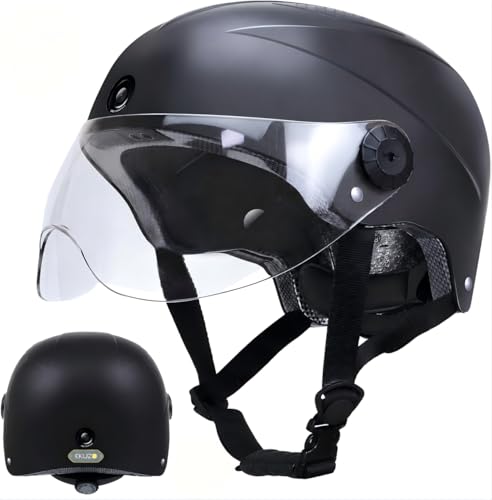
DC Smart Bike Helmet with Cameras Dual HD Front & Rear Video Recorder for Ebike & Electric Scooter, Bluetooth App Control Action Cam Helmet, CPSC Certified (Black)
Riders who want recording from both the front and rear of the helmet, controlled through a phone app, will find this model directly relevant. The listing positions it for e-bike and scooter riders as well as motorcycle use.
Key specs
- Dual HD front and rear cameras
- Bluetooth app control
- CPSC certified, Black finish
Pros
- Front and rear recording covers most of the ride
- App control lets you start and stop recording easily
- CPSC certification is listed for bicycle-style helmets
Cons
- CPSC is a bicycle standard, not a motorcycle standard, so check local rules for motorcycle use
- Camera-equipped bike helmets are not designed for highway speeds
LKT 2K Motorcycle Helmet Camera Front and 1080P Rear

LKT 2K Motorcycle Helmet Camera Front & 1080P Rear with 64GB Card, 1920mAh 5H Battery, Dual Bike Dash Cam with Sony Starvis Sensor, WiFi Night Vision Cycling Camera Bike Camera
This is a dedicated camera system for riders who want front and rear lenses with a large memory card included and who plan to mount the cameras to a helmet they already own. It suits riders who value recording over helmet integration.
Key specs
- Front camera and 1080P rear camera
- 64GB card included
- Battery rated in the listing at 1920mAh, with WiFi and night vision features
Pros
- Dual-lens setup covers the front and behind
- Large included memory card reduces setup time
- Works on helmets you already own
Cons
- Mounting on a helmet adds bulk and needs careful positioning to avoid obstructing the visor
- Battery runtime is limited for long rides, so plan for a charger or spare battery
Moman Motorcycle Helmet Headsets Speaker, Hands-Free Camera Capturing (H4C)

Moman Motorcycle Helmet Headsets Speaker, Hands‑Free Camera Capturing(H4C) | Hi-Fi Speakers Dual Noise Cancellation, Loud Sound, Voice Assistant IPX67 1080P Camera with 32G TF-Card for All Helmets
Riders who want a hands-free camera and a communication headset in a single retrofit kit, usable with most helmets, should look at this option. It is a practical choice for riders who prefer not to buy a new helmet.
Key specs
- 1080P camera with hands-free capture
- Hi-Fi speakers with dual noise cancellation and voice assistant support
- IPX67 rating, 32GB TF card included
Pros
- Works with a range of helmets, so you can keep your current lid
- Audio and camera in one kit
- IPX67 rating helps with rain and road grime
Cons
- Retrofit installation can look less clean than an integrated helmet
- Owners often report that wind noise affects audio quality at speed
Motorcycle Helmet Bluetooth Headset, Wireless Camera Recorder with 1080P

Motorcycle Helmet Bluetooth Headset, Wireless Camera Recorder with 1080P, 120°Wide Angle,HD Video/Photo, Body 360°Adjustment, Bluetooth 5.3, Smart Noise Reduction, IP66, 32GB TF Card
This compact system is for riders who want a discreet camera and Bluetooth audio with a wide field of view and adjustable mounting. It suits those who want modest, lightweight add-ons rather than a full smart helmet.
Key specs
- 1080P video with 120-degree wide-angle lens
- Bluetooth 5.3 with smart noise reduction
- IP66 rating, 32GB TF card included, adjustable body
Pros
- Wide 120-degree lens captures more of the road
- Adjustable body helps with positioning
- Bluetooth 5.3 and IP66 rating are listed features
Cons
- Compact camera may have a shorter battery runtime during continuous recording
- Adhesive or clip mounting should be checked on your helmet’s shell
Buying Guide
Before you choose a motorcycle helmet with camera built-in, decide what you need it to do. Recording a ride for personal use, documenting an incident, and adding navigation or intercom each point toward a different design. Start with the helmet first, because safety certification matters more than any electronics package.
Selection Criteria
- Certification: Look for DOT, ECE or Snell markings on the helmet itself. A camera mount should not change the shell’s certification.
- Camera placement: Forward-facing cameras capture the road ahead, while rear-facing lenses show traffic behind. Check whether the lens is in the visor area or on the shell.
- Field of view: Wide-angle lenses (120 degrees is a common spec in listings) capture more of the scene but can distort edges.
- Video resolution: 1080P is the most common listed resolution. Higher resolutions use more storage and battery.
- Battery life: Continuous recording drains batteries quickly. Plan for a charger, a spare battery, or a power connection on longer rides.
- Storage: Memory cards from 32GB to 64GB are common in listings. Check how the camera handles loop recording when the card fills.
Important Features
- Waterproofing rating such as IP66 or IPX67 for rain and road spray
- Simple start and stop controls, ideally one button or app control, so you can record without taking a hand off the grip
- Secure mounting that does not block your peripheral vision or the visor
- Audio and noise reduction if you plan to use the helmet for intercom or music
Specs to Check
- Helmet type (full-face, modular, open-face) and how it matches your riding
- Battery capacity in mAh and the runtime the manufacturer specifies
- Included memory card size and whether it is needed to record
- Connectivity: Bluetooth version, WiFi, or app compatibility
Choosing by Need
- Recording for personal use: A single forward camera with good battery life is usually enough.
- Front and rear documentation: A dual-lens system covers more of the ride, though mounting needs care.
- Communication and navigation: A smart modular or HUD-equipped helmet puts the features in one system.
- Keeping your current helmet: A retrofit camera or headset kit works on many helmets, but check fit and appearance.
Things to Watch Out For
- Do not drill, glue or heavily modify a certified helmet shell. Use the manufacturer’s mounting method only.
- Camera-equipped bicycle helmets, such as those with a CPSC certification, are not the same as motorcycle-certified helmets. Confirm the standard before relying on it for motorcycle riding.
- Check local laws about recording and mounting devices, as rules vary by state and country.
- Wind noise can affect audio clarity at highway speeds, so test your setup on a short ride before a long trip.
Some riders with medical or safety concerns should consult a qualified professional before adding electronics to their helmet.
FAQ
Is a motorcycle helmet with a built-in camera street legal?
Helmets are generally legal if they carry the required DOT or ECE certification, and a camera does not automatically make a helmet illegal. However, a camera that obstructs vision or is mounted in a way that violates the helmet’s certification may cause problems. Check your state or local rules.
Do I need a special helmet to use a camera?
Not always. Many retrofit kits mount to a range of existing helmets. Integrated smart helmets are designed around the camera and electronics, which can give a cleaner result.
What video resolution should I choose?
1080P is the most commonly listed resolution for helmet cameras and is a practical balance between image quality and file size. Higher resolutions can be useful but consume more storage and battery.
How long does a helmet camera battery last?
Runtime depends on the battery capacity, resolution and whether the camera is recording continuously. Manufacturers usually state a figure, but owners often report shorter runtimes in real riding conditions, so plan for a charger or spare battery.
Will a camera affect helmet ventilation or noise?
Mounting hardware can slightly change airflow, and wind noise may increase depending on the camera’s shape and position. Test the setup on a short ride before committing to a longer trip.
Can I use a bicycle helmet with a camera for motorcycle riding?
Bicycle helmets are not designed or certified for motorcycle speeds and impact. A motorcycle-certified helmet is the safer choice for motorcycle riding.
How should I mount a camera without damaging my helmet?
Use the manufacturer’s recommended mounting method, avoid drilling or adhesive on the shell unless the maker permits it, and keep the lens clear of your visor and field of view.
Conclusion
A motorcycle helmet with camera built-in can serve very different needs, so the right pick depends on what you want the system to do. Riders who want a single integrated smart helmet with communication should look at the modular and HUD-equipped options. Riders who want front and rear recording should consider the dual-lens systems. Riders who prefer to keep their current helmet will find the retrofit kits more practical. Whatever you choose, confirm the helmet’s certification, plan your battery and storage, and test the setup before long rides.
Related reading
- Shoei RF-1400 Full Face Motorcycle Helmet Review: Is It Worth It?
- 5 Best Full Face Motorcycle Helmet Helmets for Every Ride (2026)
- Mountain Bike Full Face Helmet Fox?
- Helmet Mountain Bike Full Face Review (2026): Who Is It For?
- 7 Best Full Face Moto Helmet Picks for Every Rider (2026)
- 7 Best Bell Mountain Bike Full Face Helmet Options for Trail Riders (2026)
About the author

maxmotorcyclevideos editorial team writes reviews and buying guides for Max Motorcycle Videos.